

"Explore the rich tapestry of the Malabar region, where centuries of history, culture, and tradition come together.

Get In Touch

img

University of Calicut,
Edapally - Panvel Hwy, Thenhipalam,
Kerala 673635, India

Malabar History journal

  • Home
  • Malabar History journal
Blog Image

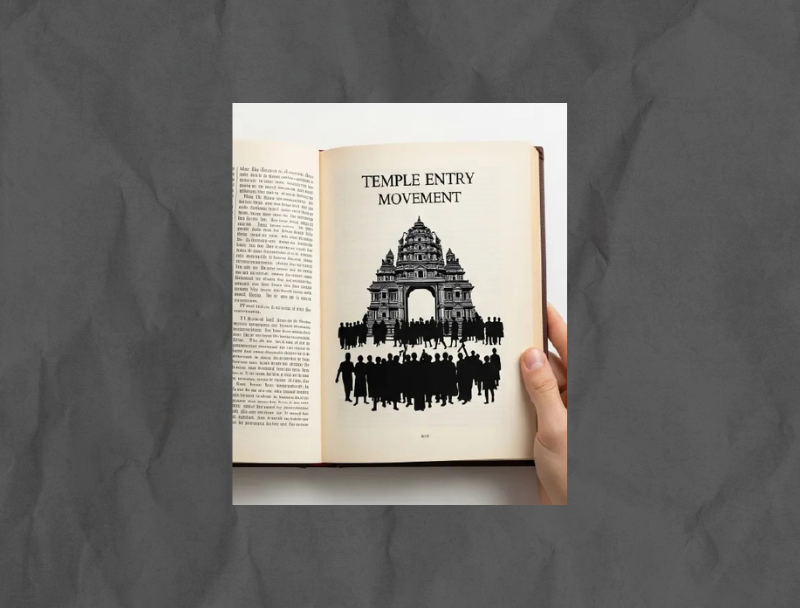
Temple entry movement in British Malabar

The term “Temple Entry Movement” refers to the social and political struggles against caste-based discrimination held in British Malabar, which denied lower-caste Hindus the right to enter and worship Hindu temples reserved for the upper-caste Hindus.

Not only temples, the lower castes were also not allowed to carry umbrellas, wear shirts, blouses, shoes, or gold ornaments, carry pots of water on the hip, build houses above one storey or milk cows. Women of these castes were not even allowed to cover the upper part of their bodies.

Background

The temple entry movement originated alongside the nationalist movement in the region. Initially, leaders of the freedom struggle held meetings and passed resolutions reaching out to the public and religious organizations to end the practice of untouchability. They also fought against the denial of access to public spaces for the untouchables. For example, lower castes were forbidden from entering roads near the Calicut Tali temple, arguing that their presence would pollute the region.

They called for the elites to open all public roadways to lower castes, rejecting such beliefs as mere superstition. To challenge established elite customs, they also walked down the road near the Tali temple with a group of men from various lower castes. This encouraged ordinary people to also walk down the road near the Tali temple and even remove the board prohibiting lower castes from entering it.

Moreover, during the All Indian Congress Committee (AICC) meeting of 1923 in Kakinada, it was decided to move strongly for the elimination of untouchability. All provincial committees of the party were given directions accordingly. The Kerala Provincial Congress Committee responded by launching an immediate movement demanding that all public roads and spaces, including temples, be opened to lower caste people. This led to the historic Vaikom Satyagraha, which began on March 30, 1924, in the Vaikom temple of the Kingdom of Travancore. The success of the Vaikom Satyagraha served as a catalyst to strengthen the human rights movements in Malabar.

The Kerala Provincial Congress sub-committee formed to abolish untouchability believed that allowing lower castes to enter temples was crucial to eradicating the practice of untouchability. The Congress leaders like K. Kelappan, T.R. Krishna Swami Iyyer, A.K. Gopalan, and others strongly criticized conservative Hindus who denied lower castes entry into temples. They argued that there was no basis for untouchability in Hindu scriptures and that it was created by wealthy individuals to maintain their power and suppress the development of others. These views were expressed at the sixth Kerala provincial political conference held in Badagara on May 4th and 5th, 1931, which was presided over by Mr J. M. Sengupta. The conference decided to launch an anti-untouchability campaign as one of the Congress’s programs in Kerala for the following year and demanded to open all temples to all Hindus, regardless of their caste.

On July 9, 1931, K. Kelappan attended the All India Congress Committee conference in Bombay. He spoke to Mahatma Gandhi and the Congress working committee about the need for a temple entry movement in Kerala. Gandhi suggested that Kelappan initiate a temple entry movement in Malabar. Subsequently, a Kerala Provincial Congress Committee meeting was held on August 2, 1931, in Calicut, where a formal resolution was passed on the issue of temple entry. The meeting decided to launch a satyagraha in front of the Sree Krishna Temple in Guruvayur.

After the resolution was passed, K. Kelappan, along with other leaders such as A.K. Gopalan, N.P. Damodaran, Mannath Padmanabhan, M. Karthiyani Amma, T.S. Tirumumb, K.P. Kayyalakkal, and others, traveled throughout Kerala to inform and mobilize the local communities about the movement. They organized a series of meetings and processions to explain the Temple Entry Satyagraha program and highlight the need to eliminate the evil of untouchability.

Guruvayur Satyagraha

The Guruvayur Temple Entry Satyagraha, a historic temple entry movement in Malabar, thus began on November 1, 1931, at the eastern entrance (Kizhakke Nada) of the Guruvayur temple. The leader of the Satyagraha, K. Kelappan, delivered a speech marking the start of the movement.

In September 1932, M.K. Gandhi declared a hunger strike to protest against the government’s decision to create separate electorates for scheduled castes in India. Considering this an opportunity to increase momentum for the temple-entry movement, Kelappan too decided to go on a hunger strike in front of the Guruvayoor temple. However, Kelappan’s health worsened with the fast. Gandhi and other prominent leaders of the Indian National Congress advised him to stop his fast. Kelappan called off his fast on October 2, 1932, on the birthday of Gandhi.
Later, despite their efforts to intensify, the Satyagraha proved unsuccessful, and it took four more years for a significant change to occur in Kerala with the opening of many temples to all in 1936.

Swami Anananda Theerthan is one of the other prominent personalities who played a crucial role in the temple entry movement in Malabar later on, extensively promoting it to the lower castes in Ezhome village in the present-day Kannur district of Kerala and other areas in north Malabar. He urged them to boycott the customary presents and offerings made to the temple during festivals and encouraged them to protest against temples that still barred untouchables from entering, even after the Madras Temple Entry Authorization Act passed on June 2, 1947, which allowed all Hindus to enter temples in Madras Presidency.

References

  • T. Natarajan. (1996). Social Stratification, Temple Entry Movements and Consequent Constitutional Reforms in Madras Presidency 1919–1947 [Doctoral Thesis, Department of Politics and Public Administration, University of Madras].
  • E.L. Shivathambika. (1991). The Untouchables and Their Struggle for Temple Entry in Kerala, Since 1920 [Doctoral Thesis, Department of History, Union Christian College, Alwaye].
  • Dr. M. Madhavan. (2018). Social Dimension of Human Rights Violation: Temple Entry Movements in Malabar. Review of Research. Accessed on 15.04.2023 from http://oldror.lbp.world/UploadedData/6717.pdf