


"Explore the rich tapestry of the Malabar region, where centuries of history, culture, and tradition come together.

Get In Touch

img

University of Calicut,
Edapally - Panvel Hwy, Thenhipalam,
Kerala 673635, India

Malabar History journal

  • Home
  • Malabar History journal
Blog Image

Portuguese Fortresses on the Malabar Coast

With the arrival of the Portuguese, the competition for commercial dominance in India began, with Malabar serving as their initial foothold. The western coast of India attracted the Portuguese due to its abundant spice resources and its strategic location near the Red Sea-Venice trade route. After arriving in Malabar in 1498, they employed various strategies to control the spice trade. The Portuguese soon recognised that a large portion of spices was being transported to Red Sea ports and then on to Alexandria and Venice. The Portuguese identified that Egyptians merchants (al-Karimi) dominated the Calicut-Red Sea/Arabia trade, viewed them as their commercial rivals, upon seeing them as the backbone of Red Sea trade.

The Portuguese next focused on taking control of the spice trade by identifying key spice-producing regions and driving out Muslim merchants involved in the trade. To regulate the flow of goods toward the Arabian Sea, they established a network of fortresses and conducted regular coastal patrols. This strategy aimed to prevent the diversion of spices and other valuable goods they sought to monopolise. Albuquerque, the governor at that time believed that trade with India would be unsafe without military strength backed by fortresses. He emphasized the importance of military power, with fortresses guarded by ship-mounted guns. The patrolling fleet (armada) was deployed along the western coast, specifically covering the maritime zones from Cape Comorin to Cochin, Cochin to Goa, and Goa to Cambay. The two main reasons for building fortresses along the Malabar coast was to intimidate local rulers and control the export of pepper trade. To gain access to inland areas, the Portuguese initially formed alliances with minor local chiefs. However, Francisco de Almeida shifted this policy, advocating for consolidating power at sea rather than on land.

The first Portuguese fortress was established in Kochi in 1503 A.D., which later modified, and became the seat of the Esatado de India in 1505 A.D. Other fortresses were established in Cannanore (1508), Calicut (1513), Quilon (1519), Chaliyam (1531) Cranganor (1536). These fortifications were also an attempt to consolidate power locally. As a result, maritime regions of Malabar passed into Portuguese control. Beyond Malabar, they built fortresses in Bassein 1534, Diu 1536, Daman 1559, Mangalore 1568, Barcelor 1568, Honawar 1569.

The fortresses built in Honawar, Barcelor, and Mangalore were intended to prevent Muslim merchants from exporting rice to Arabia, Malabar, and Goa. The Portuguese chose Cochin as the site for their fortress and Estado da India because of its strategic location. Surrounded by backwaters, Cochin was easier to defend than a mainland position, and the waterways also facilitated communication. It was also close to key pepper-producing regions. Afonso de Albuquerque constructed a rampart near the anchorage for ships. To handle local conflicts and regulate pepper prices, a fortress was built in Cannanore in 1508, which Francisco de Almeida named Sant’ Angelo. The fortress was defended by 200 men, including 50 armed soldiers, and was supported by two caravels.

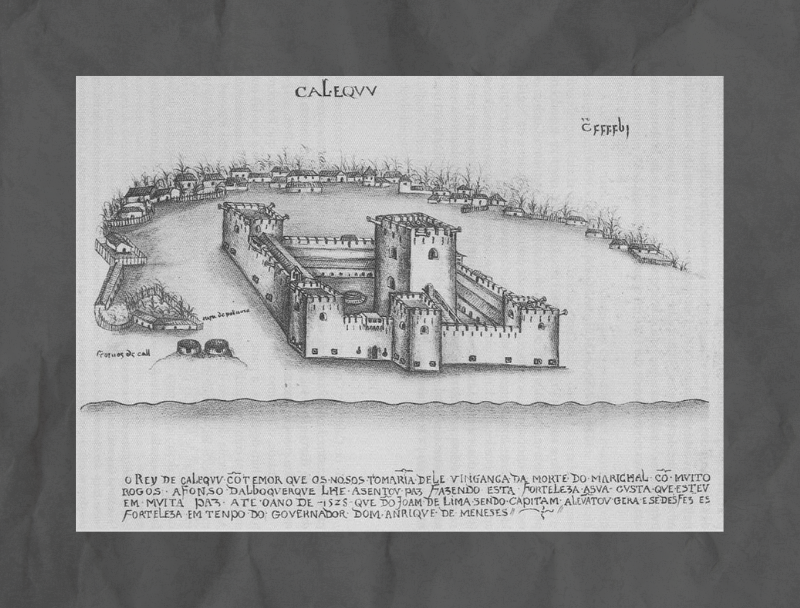
In 1515, Portuguese constructed a fortress in Calicut, led by Thomas Fernandez, following the 1513 treaty that granted them permission to do so. Francisco Noqueira was appointed captain of the fort. Under the agreement, all spices and medicinal products from the Zamorin’s territory were to be sold to the Portuguese at a fixed price, and in return, the Portuguese would pay customs duties to the Zamorin. Although they had promised not to harm the local population, once the fortress was completed, they became arrogant and began attacking people and ships in the harbour. In 1525, Zamorin eventually captured the fortress. The people of Darmmadam, Edakkad, Kannur, Tiruvangad, Ezhimala, and Chemmad united against the Portuguese. Additionally, Muslim leaders in Cochin, including Faqih Ahmed Marakkar and Kunhi Ali Marakkar, travelled to Calicut to join the resistance.

The Chaliyam fortress was constructed to control the Zamorin’s trade. They recognised that the river Chaliyar (Beypore river) flowed through the heart of the Zamorin’s territory. So, a naval base at Chaliyam strategic for accessing interior parts of the region and disrupting the internal trade routes. The fortress featured a strong garrison and advanced artillery, distinguishing it as the largest Portuguese fort in Malabar. Positioned at the mouth of the Chaliyar River, the fort was encircled by the river on one side and the Arabian Sea on the other. The fort established in 1531 A.D. The Zamorin attacked the fortress of Chaliyam and after a four-months of siege, captured it in 1571 A.D.

When the Portuguese realized that a large portion of pepper was being transported from Cranganor to the Red Sea, they decided to construct a fortress there in 1536. It was D. Francisco de Almeida who recommended to King Dom Manuel of Portugal to build a castle in Cranganor, at a river passage leading to Calicut, with the aim of obstructing even a small amount of pepper trade. Dom Miguel Bolin built the fort, which measured 100 fathoms in length from bastion to bastion, 3 fathoms in height, and 6 spans in width. The fortress was equipped with a garrison and artillery and was under the in charge of a captain. The complex included a cathedral with an Archbishop, a hospital, and residences for priests. The nearby settlement was home to Portuguese and native couples, was surrounded by a wall measuring 60 fathoms in length and 15 spans in height.

In 1528, after a Portuguese ship was wrecked at Tanur, the King of Tanur offered shelter to the survivors and formed an alliance with the Portuguese. This agreement led to trade voyages using Portuguese-issued passes and permission to build a fort north of the Ponnani River, within the King’s territory. However, during the transport of bricks and building materials from Cochin, a Portuguese ship was caught in a violent storm at the Ponnani anchorage and wrecked. Some of the crew and slaves drowned, while those who reached Veliyancode’s shore were captured and killed. Muslim forces freed the Portuguese prisoners, and the Zamorin acquired the ship’s large cannons. Later, in 1579 again the Portuguese sought permission from the Zamorin to build a fortress in Ponnani, which they received in 1583.

References

  • Geneviève Bouchon. Regent of the Sea: Cannanore’s Response to Portuguese Expansion, 1507–1528. New Delhi: Oxford University Press, 1988, p. 78.
  • K.V. Krishna Ayyar. The Zamorins of Calicut: From the Earliest Times Down to A.D. 1806. Calicut: University of Calicut, 1999.
  • K.M. Panikkar. Malabar and The Portuguese. Bombay: D.B. Taraporevala Sons & Co, 1929.
  • Quazi Muhammed bin Abdul Azeez. Fathuhul Mubeen, Malayalam trans. Prof. Mankada Abdul Aziz. Calicut: Alhuda Book Stall, 1996.
  • Shaykh Zainuddin Makhdum. Tuhfat al-Mujahidin: A Historical Epic of the Sixteenth Century, trans. S. Muhammad Husayn Nainar. Calicut: Other Books, 2005.
  • Pius Malekandathil. Maritime India: Trade, Religion, Polity in the Indian Ocean, Revised Edition. New Delhi: Primus Books, 2013.