




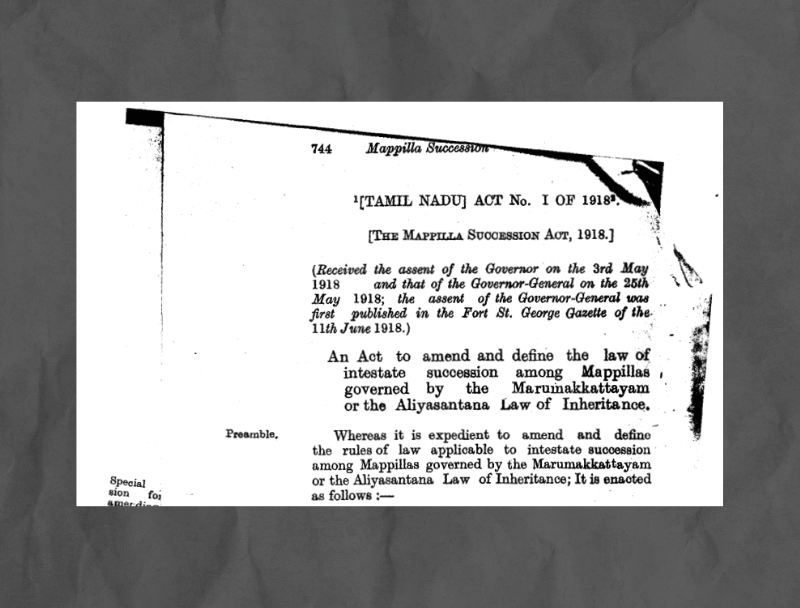
Mappila Succession Act, 1918
The Mappila Succession Act, 1918 was an important legislative enactment for the Indian Muslim communities, particularly the Mappilas, who lived in the Malabar region of present-day Kerala. Enacted in the year 1918, this Act aimed to address complex issues surrounding inheritance and property succession within the Mappila community, specifically related to the division of self-acquired property. It was the normative ideal of Anglo-Muhammadan law that led to the legislation of the Mappila Succession Act.
Background
The Mappila Succession Act emerged in the early 20th century in response to customs in Malabar, where self-acquired property reverted to matrilineal property after an individual’s death. While both men and women had rights over the joint family property, only women inherited it. However, men increasingly started to acquire individual property, leading to disputes over the dissolution of such property. The Malabar Wills Act, 1898 allowed individuals to gift their property by way of a will, which facilitated the transfer of ownership to their children and wives after their death.