


"Explore the rich tapestry of the Malabar region, where centuries of history, culture, and tradition come together.

Get In Touch

img

University of Calicut,
Edapally - Panvel Hwy, Thenhipalam,
Kerala 673635, India

Malabar History journal

  • Home
  • Malabar History journal
Blog Image

Malabar Rebellion and the fanatic Mappilas

Two concepts that shaped colonial reports and correspondences on the Mappila rebellion were inherent criminality and religious fanaticism. The colonial government used these and similar tropes and labels throughout India to manage insurgencies and reinscribe the reasons for their emergence. “Effeminate Bengalis,” “martial races,” “primitive,” and “fanatic Muslims” were some such labels. These were not mere labels; they organized knowledge about insurgencies in specific ways, structured the punitive measures the government undertook, and, in turn, affected relationships between castes and communities.

The colonial reports on Malabar distinguished between jungle/fanatic/criminal/professional robber Mappilas residing in interior regions and gentle or well-behaved Mappilas in the coastal areas. This distinction roughly corresponded to indigenous Muslims who had moved to the interior parts of Malabar after the Portuguese invasion and Muslims of Arab lineage engaged in trade and living in the coastal region. Land-related disputes primarily affected the former group, as their income was derived mainly from agricultural labor or yield.

An early illustration of the criminalization of Mappilas is found in the Malabar Joint Commissioners’ report published in 1793, a year after the East India Company took over the administration of Malabar. John Wyre, another officer, identified Mappilas in 1800 as “very turbulent and prone to robbery.” The Board of Revenue Consultations in 1802 described Mappilas as robbers and bandits. However, the stereotypical labeling of fanaticism had not yet entered colonial records.

These early references to Mappilas as having a propensity for criminal acts emerged in the context of their resistance to the colonial government’s decision to restore land rights to landlords who had fled the region during Mysorean rule. Mappila Rebels such as Unni Musa protested the new land tenure policy, and he, along with other rebels like Athan Gurukkal of Manjeri, fought the British and engaged in guerrilla warfare. The land granted to the latter by the Zamorin was confiscated. These rebels were defeated by 1801, and it is in this context that references to a tendency for robbery appeared in colonial reports.

The label of fanaticism appears frequently in reports and correspondence from the nineteenth century. Categorizing Mappilas as fanatics allowed colonial officers to reduce the complex reasons behind the Mappila outbreaks—during which they murdered landlords and their aides—to a purely religious explanation. Colonial documents constructed a specific narrative that downplayed or dismissed the injustices Mappilas faced due to the government’s land policies, instead emphasizing the religious fervor with which they fought the British.

The reports highlighted the connections between participants in the outbreaks and religious leaders such as thangals. The decision to deport Sayid Fazl in 1852 by the district collector was based on the claim that he was the key instigator behind many rebellions. Testimony provided by a former Deputy Collector of Malabar to the William Logan Commission of 1881–82 alleged that Sayyid Fazl, who delivered Friday sermons at the Mamburam mosque, declared that killing a jenmi who evicted tenants was not a sin but rather a meritorious act. Furthermore, the reports stated that participants in the outbreaks either visited or made vows at religious sites, such as the burial places of martyrs or mosques, and spent considerable time in prayer. In some cases, participants made public vows to die fighting certain landlords. For instance, the leader of the 1884 outbreak is reported to have made a solemn oath to become a shaheed before the congregation of the Churott mosque, from which many other participants were recruited.

The reports also emphasized the significance of the concept of shahada (martyrdom) among Mappilas. Accounts of the outbreak on 22 November 1841 stressed the Mappilas’ willingness to die despite opportunities to escape capture and death. Many other reports noted that participants in the outbreaks, after committing murder, took refuge in a mosque or nearby temple, awaited the arrival of troops, fought until the end, and were ultimately killed. According to colonial government records, 29 outbreaks occurred between 1836 and 1919, involving 352 participants, of whom only 24 were captured alive. The Mappilas’ refusal to surrender and their verbal exchanges with the troops were characterized as manifestations of a kind of madness—halilakkam. The Valluvanadu, Eranadu, and Ponnani Taluks were often referred to as “fanatic zones” in administrative reports. Muslims constituted more than sixty percent of the population in these regions. However, in a report written in 1849, the Malabar collector Conolly remarked that Mappila traders in the so-called fanatic zone remained tranquil.

While colonial officers were aware of the problem of land tenure, they did not pursue this explanation further because it failed to address key questions: Why did Hindu peasants in similar situations not respond? Why was the violence not limited to landlords? T.L. Strange, appointed in 1852 to study the Mappila outbreaks, examined thirty-one instances of outbreaks and concluded that these incidents or threats thereof were not the result of persecution by landlords but were due to fanaticism, pride, and intolerance fostered by the ‘Mohammedan faith.’ Strange was tasked with investigating the problem of ‘fanaticism,’ but he was also instructed to ensure the protection of Nairs and Brahmins against it. Mappila fanaticism was assumed to be a permanent characteristic—a disease rather than a symptom.

William Logan, in his report from the early 1880s, criticized Strange’s conclusions and suggested granting occupancy rights to tenants and laborers under certain conditions. Yet, Logan’s descriptive account of the events was organized around the actors’ race, religion, and caste. He made a distinction between Arab Muslims and Indigenous Muslims. The former, he wrote, “have a great regard for truth, and in their finer feelings, they approach nearer to the standard of English gentlemen than any other class of persons in Malabar” (William Logan 108, quoted in Ansari 2015, p. 77). The indigenous Mappilas were described as ‘frugal,’ ‘thrifty,’ ‘industrious,’ ‘serviceable,’ and ‘reliable’ in emergencies. However, Logan added that “they become attached to those who treat them well but must be dealt with a firm hand” because of their toughness. He also noted that they were ignorant and therefore easily misled into committing violent acts.

Logan echoed Duarte Barbosa (1480–1520), a Portuguese officer based in Cochin, as he cautiously noted that the region might have become an Islamic land, either by force or conviction, had the Europeans not arrived. Logan’s characterization draws a distinction between trading/gentle Mappilas and jungle/indigenous Mappilas, emphasizing the latter’s gullibility, proneness to violence, and fanaticism.

For colonial officers, religion served as the primary category to conceptualize Muslims and frame the nature of their responses. Other categories, such as peasant, working class, and lower caste, were overlooked, despite these being central to the issues Mappilas faced. Testimonies from Mappila fighters attached to colonial documents reveal that they committed murders or attacks in response to the treacherous actions of landlords who sought to evict them or those connected to them. These documents show that landlords often obtained court orders for eviction, and colonial officers frequently disregarded the Mappilas’ side of the story. The violence involved, the deprivation of cultivators’ rights, changes in land tenure that marginalized the Mappilas and crippled their livelihoods, and the nexus between landlords and colonial officers were ignored.

Logan notably illustrated an incident in which Mappilas took an oath to die as martyrs in their fight against the Portuguese in 1507. The label of fanaticism was not invoked here; trade concerns were cited as the driving force behind the ‘courageous’ acts of these Arab Muslims, which Logan commended. Yet, when it came to indigenous Muslims—many of whom were converts from lower castes—religion, rather than their caste disabilities or agrarian grievances, framed Logan’s narration of the problem. This demonstrates how the attribution of such labels, rather than describing their true nature, constructs it in a specific way.

The erasure of the underlying reasons behind these outbreaks and the creation of a narrative framework in colonial reports—which described each outbreak as a new, often more outrageous iteration of the previous one—helped to conjure up the image of the “fanatic Mappila” and his “animality.” Most records emphasized their religious zeal, especially during Ramadan, their desire for martyrdom and death, their ignorance, blind faith in the power of rituals, hatred of Hindus, propensity to be swayed by the misinterpretations of their religious priests, proneness to commit murder without provocation, and ease of being incited, as outlined above.

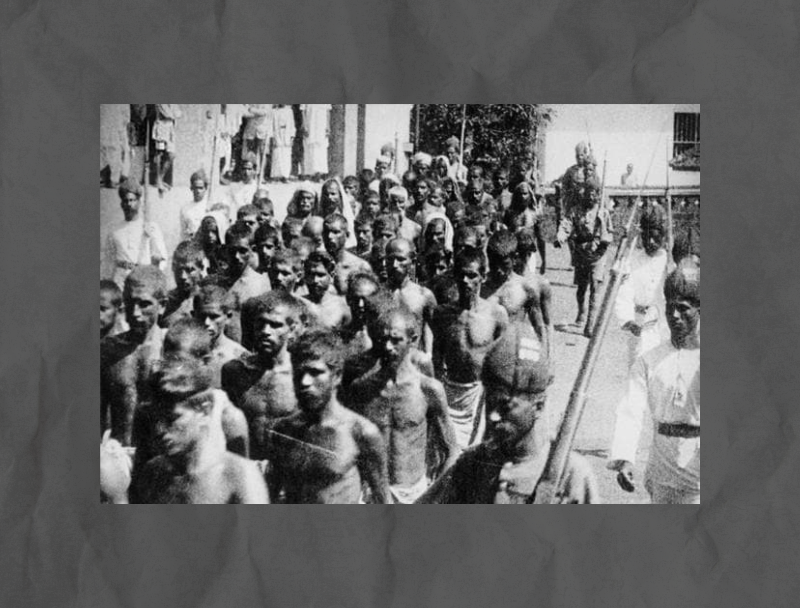
After the 1921 Malabar Rebellion, leaders of the nationalist movement echoed the perspectives of colonial officers. Gandhi, who visited Malabar in 1920 along with Shaukat Ali to instill in the people the spirit to resist the British government, reduced the rebellion to an outgrowth of the Mappilas’ inherent fanaticism. During a speech in 1920, Shaukat Ali made the following appeal: “If you are strong and capable, then it is your bounden duty, so long as one Musalman breathes, to fight the unjust king, the unjust government that proved to be an enemy to your faith and to your God” (cited in Ansari 2015, p. 91). However, as the rebellion escalated into violent confrontations between Hindus (mostly landlords) and Mappilas, and was brutally suppressed by colonial police and military forces, Gandhi placed the blame squarely on the religious zeal of Muslims even before fully understanding the situation. He wrote:

The Moplahs are Muslims. They have Arab blood in their veins. It is said that their forefathers came from Arabia many years ago and settled in Malabar. They are of a fiery temperament and are said to be easily excitable. They are enraged and resort to violence in a matter of seconds. They have been responsible for many murders. . . . They always set out for fighting with a pledge not to return defeated. . . . It is not clear as yet what led to their present outburst (CWMG, 1976, vol. 21, pp. 47–48, cited in Ansari 2015, p. 90).

The figure of the “fanatic” continues to haunt the history of the community. This perception was evident in the central government’s decision in 2021 to remove 387 names of Mappila martyrs from the Dictionary of Martyrs of India’s Freedom Struggle, citing a review committee’s report that claimed the Malabar Rebellion was not part of the independence struggle but focused on religious conversion.

References

  • Abraham, Santhosh. 2014. “Constructing the ‘Extraordinary Criminals’: Mappila Muslims and Legal Encounters in Early British Colonial Malabar.” Journal of World History 25 (2): 373–395.
  • Ansari, M. T. 2015. Islam and Nationalism in India: South Indian Contexts. London: Routledge.
  • Dhanagare, D. N. 1977. “Agrarian Conflict, Religion and Politics: The Moplah Rebellions in Malabar in the Nineteenth and Early Twentieth Centuries.” Past & Present, no. 74: 112–141.
  • Kodur, A. K. 2021. 1921 Anglo-Mappila Yudham (1921 Anglo-Mappila War). Calicut: IPH.
  • Wood, Conard. 1975. The Moplah Rebellion of 1921–22 and Its Genesis. PhD Thesis. School of Oriental and African Studies.