
"Explore the rich tapestry of the Malabar region, where centuries of history, culture, and tradition come together.

Get In Touch

img

University of Calicut,
Edapally - Panvel Hwy, Thenhipalam,
Kerala 673635, India

Malabar History journal

  • Home
  • Malabar History journal
Blog Image

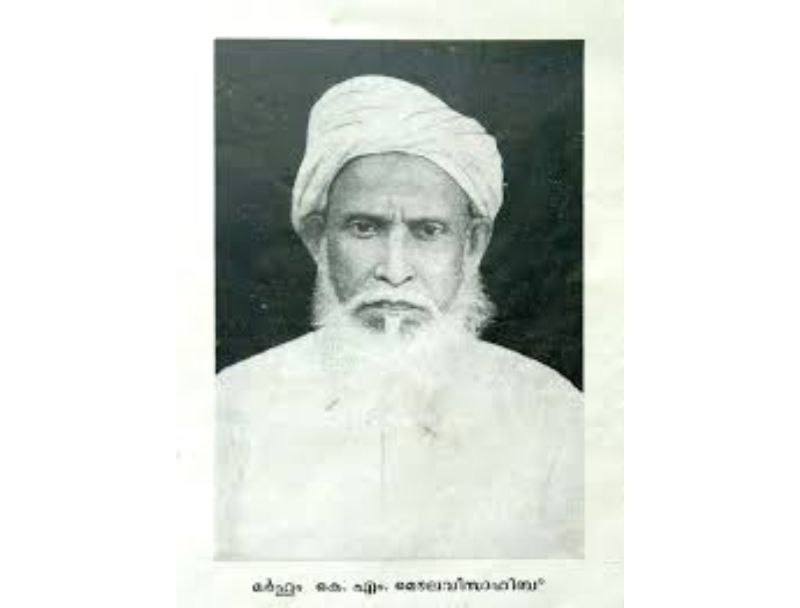
K.M Moulavi

K.M. Moulavi(1886-1964) was a prominent scholar, reformer and freedom fighter. He was one of the earliest leaders of the Islahi movement in Malabar.

Biography

Kaathib Thayyil Mohammed Kutty Musliyar, popularly known as K. M. Moulav was born on 6 July 1886 to Thayyil Kunji Moideen and Kannaattil Aysha in Kakkad of Malappuram district.

He married Fathima; his children were Kunjahmed, Abdulla, Abdussamad, Kunji Muhyidheen, Muhammad and Aysha. He received primary religious education from the religious school of Kuriyaadan Ahmed Kutty Molla. He studied under the prominent scholar, Chalilakath Kunjahmed Haji at Darul Uloom of Vazhakkad. Further, he studied hadees under Kattilasseri Muhammad musliyar and Arabic literature under Vakkom Abdul Qadir Moulavi. He learnt the Urdu language from a renowned Unani physician of Kodungalloor named Abubacker moulavi, shaikh Ali moulavi, and Abdulla al Yamani of Cochin.

K.M. Moulavi followed Chalilakath Kunjahmed haji after he stopped teaching at Darul Uloom and moved to a Dars in Mannarkkad. After chalilkath passed away while he was a teacher at the Dars in Mannarkkad, K.M. Moulavi became a teacher there. He also held Dars near Chemmankadavu of Malappuram district. He was a participant in the conference of delegates of “Indian Majlisul Ulema” held on 2 and 3 April 1921. From there he was involved in discussions on spreading the Khilaft-Congress struggles across Malabar. After the conference, ‘Majlis ul ulema’ came into existence. He gave fatwas in the Malayalam newspaper ‘Al Irshad’published by All Kerala Muslim Aikyasangham. He died on 10 September 1964.

Anti-British struggles

He came to politics through the home rule league of Annie besant. In 1920, he became a part of the non-cooperation movement against the British, jointly promoted by the Congress party and the Khilafat movement. He served as the Khilafat-Congress Secretary of Ernad Taluk of Malabar province. During that period, he took the initiative to start Khilafat-Congress organizations in Eranad, Valluvanad, Kozhikode and Ponani Taluks. His active involvement in anti-British struggles led the then-Malabar collector E.F. Thomas to file a chargesheet against him. During the Battle of Pookkottur and Tirurangadi struggles, he moved along with Muhammad Abdu Rahman Sahib and K.P. Kesava Menon to console the affected people of the community. He strove for the acquittal of the participants of the Malabar rebellion who were charged with criminal offences.

Due to the arrest warrant issued against him by the Britishers, he moved to Kodungalloor. In Kodungalloor, he was supported by Kottappurath Seethi Mohammed Sahib who was the father of K. M. Seethi Sahib and Manappattu Kunjahammed Haji. He was influenced by Vakkom Moulavi and conducted sermons criticizing superstitions and strengthened the reform movement there. After 11 years of living in Kodungalloor, Moulavi returned to Malabar. When the Mathrubhumi newspaper faced financial crises, he raised funds to meet its losses. He joined the Muslim League in 1935 and served the organization as its vice president. He also published a monthly in the Arabi-Malayalam language titled ‘Al Murshid magazine’ in 1935. After four years, the magazine stopped its publication due to less number of subscribers and the high price for paper. In 1949, the magazine was re-published with K.M. Moulavi as its editor. Although, the magazine stopped short due to a lack of common agreement among the members of Kerala Jam’iyyatul Ulema regarding their religious and political standpoints.

He was the former president of Kerala Jam’iyyatul Ulema. In 1950, he became the founding president of Kerala Nadvatul Ulema. For 13 years, until 1962 he remained as its president.

Major Contributions

An orator, writer and organizer, Moulavi was also a good polemicist. He participated in various debates with the leaders of Samastha Kerala Jam’iyyatul Ulema. After translating a portion of the 30th section of the Holy Quran into the Arabi-Malayalam language, he established ‘The Muslim Literature Society’ to translate the Holy Quran completely. However, only two parts of the translation could be released. He wrote for magazines such as Al Ameen, Chandrika, Al Ittihad, Ansari, Al Manar and Al Hidaya and translated many articles of Abul A’la Maududi and Maulana Abul Kalam Azad from Urdu to Arabic and Malayalam. He wrote books namely, ‘Al Hidaya ila nahqil bida’ee vadhalaala, al vilayatu wa al karaama and Risalatun fil banki. His work ‘Risalatun fil banki’ which looked into the possibilities of an Islamic banking system received criticism from his associates. Moreover, he was also one of the founders of Tirurangadi orphanage and Raudathul Uloom Arabic College.

References

  • V. M. Ibrahim. “K. M. Moulavi.” Prabodhanam Special Edition ‘98.
  • “Celebrity – K. M. Moulavi.” Kerala.com. Accessed on 8 December 2022 from

    http://www.kerala.com/pages/celebrity-K-M-Maulavi
  • Harun Kakkad. കെ.എം മൗലവി കേരളത്തിന്റെ കാത്തിബ്. Shabab Weekly. Accessed on 15 December 2022 from

    https://shababweekly.in/k-m-moulavi/
  • “K. M. Moulavi.” DBpedia. Accessed on 8 December 2022 from https://dbpedia.org/page/K._M._Maulavi
  • “K. M. Maulavi.” Wikipedia. (2021, September 26). Retrieved from

    https://en.wikipedia.org/wiki/K._M._Maulavi