


"Explore the rich tapestry of the Malabar region, where centuries of history, culture, and tradition come together.

Get In Touch

img

University of Calicut,
Edapally - Panvel Hwy, Thenhipalam,
Kerala 673635, India

Malabar History journal

  • Home
  • Malabar History journal
Blog Image

Estado da India (Portuguese State in India)

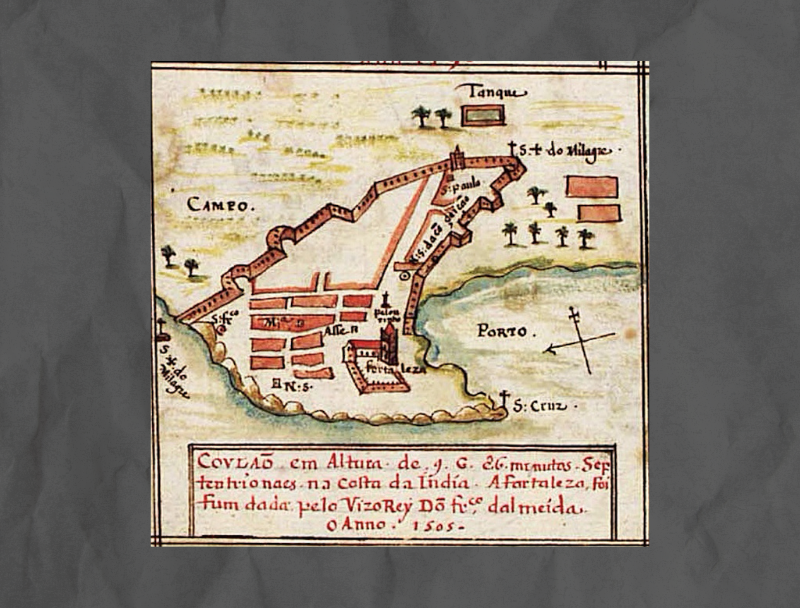
Estado de India denotes the Portuguese state in India. The Portuguese state in India emerged in the 16th century. Cochin was the initial seat after the construction of a fortress in 1503 and made it as the seat of Estado de India. But later they moved to Goa and made Goa as the base of their operations in India in 1530.

The first step taken toward the formation of the Portuguese state was the setting up of a fortified headquarter in Cochin with a permanent viceroy in 1505. The attempt was to localise power, further reinforced by erecting armed fortresses in Cannanore, Anjediva, Kilwa, etc. Next move was Albuquerque advocating land-oriented expansion by establishing fortresses at various parts of Malabar to control the vessels carrying spices on the sea and to block the transport of spices from spice-producing pockets of the interior. This extended onto the sea. Consequently, they occupied Goa (1510), Malacca (1511), and Hormuz (1515). Pius Malekandathil argued that only with the land-oriented expansion of Albuquerque did the extent of fluid power of Portuguese solidify into a perceptible territorial entity.

The Portuguese policy of expansion was systematically initiated with the appointment of Francisco de Almeida in 1506. One of their first moves was the overthrow of the Muslim dynasty of Kilwa, a significant East African port engaged in gold trade with Sofala. Further, establishing a foothold in Mozambique paved the way for the foundation of Goa as the capital of the Estado da Índia in 1510. Subsequent captures of Malacca in 1511 and Hormuz in 1515 secured control over two of the most lucrative centres of emporium trade in the Indian Ocean. The Portuguese had realised that three strategic locations in the region as vital hubs for trade: Malacca, Aden, and Hormuz. These were considered the ‘keys’ to controlling commerce in that part of the world. However, historian K.N. Chaudhuri argues that Cambay and Calicut, two prominent Indian port cities played significant roles in trans-oceanic trade, yet they remained outside the formal sphere of Portuguese state.

From the days of Afonso de Albuquerque, the Estado da India adopted a different policy and attitude, which was to promote demographic strength and ensure a supportive generation. Albuquerque asked the Portuguese soldiers to marry local women and various inducements were offered to them to become permanent residents of the new settlements. For the sustenance of married Portuguese, Albuquerque allowed them to engage in petty trade, permitted them to set up shops and manufacturing units like shoe making, baking, tailoring. This was to carve out a free space for the Portuguese. Thus, by 1520, Portugues Casado traders emerged as capable of ousting the Muslim mercantile intermediaries in the Indian ocean trade and eventually turned out to be suppliers of cargo from various Asian marts for Lisbon bound vessels. While this policy produced generations of Portuguese citizens with mixed blood and a hierarchy of status defined by colour, it also signified a will towards an assimilation of cultures and the diffusion of the Portuguese language as a means of communication and learning. By the second half of the sixteenth century, there were people born to Portuguese in the Indian Ocean who had never visited Europe.

The initial presence of the Estado da Índia in Malabar was prominently marked by its armadas, artillery, battalions of soldiers, fortified structures, transportation networks, administrative systems, skilled diplomats, military officials, and ecclesiastical representatives. These state agencies actively worked to make the various principalities of Malabar subordinate to the political and economic ambitions of the Portuguese. The internal disputes within royal families often provided opportunities for Portuguese interference.

In 1533, the Portuguese incorporated supportive rulers by granting them annuities as reward for their assistance in supplying spices to Portuguese factories. This practice effectively transformed local spice-producing chiefdoms and principalities into extensions of the Portuguese state. These monetary rewards not only diminished the chiefs’ allegiance to the Zamorin but also tied them to the Portuguese controlled Cochin principality, further consolidating Portuguese influence in the region.

The full apparatus of naval warfare, the assertion of exclusive sovereignty over the seas, and efforts to maintain a monopoly on the spice trade remained integral parts of the official policy of the Estado da India. In the early 16th century, Malabar spices and cartaz gave huge profits to the Portuguese. The latter half of the sixteenth century, the growth of Portuguese trade and settlements in South China Sea became a crucial element in the prosperity and achievements of the Estado da India. However, by the close of 16th century, Estado became weak. They became targets of corsairs, who began attacking their vessels. Interestingly, by this time, the casados had emerged a bourgeois class due to their private trade to Eastern coast of India and Southeast Asia. Casados even rose to the position of lending money to the Estado da India as loans. In the subsequent years, the Portuguese had to face the fellow European enemy i.e. the Dutch East India Company in the Indian Ocean.

References

  • Pius Malekandathil. Maritime India: Trade, Religion, Polity in the Indian Ocean, revised edition. New Delhi: Primus Books, 2013.
  • K.N. Chaudhari. “The Portuguese Maritime Empire, Trade and Society in the Indian Ocean During Sixteenth Century.” Portuguese Studies, Vol. 8, Special Issue, 1992. Supported by the Comissão Nacional para as Comemorações dos Descobrimentos Portugueses.
  • E.G. Ravenstein, trans. and ed. A Journal of the First Voyage of Vasco Da Gama 1497-1499. London: Hakluyt Society, 1898.
  • K.M. Panikkar. Malabar and The Portuguese. Bombay: D.B. Taraporevala Sons & Co, 1929.
  • Shaykh Zainuddin Makhdum. Tuhfat al-Mujahidin: A Historical Epic of the Sixteenth Century, trans. S. Muhammad Husayn Nainar. Calicut: Other Books, 2005.