
"Explore the rich tapestry of the Malabar region, where centuries of history, culture, and tradition come together.

Get In Touch

img

University of Calicut,
Edapally - Panvel Hwy, Thenhipalam,
Kerala 673635, India

Malabar History journal

  • Home
  • Malabar History journal
Blog Image

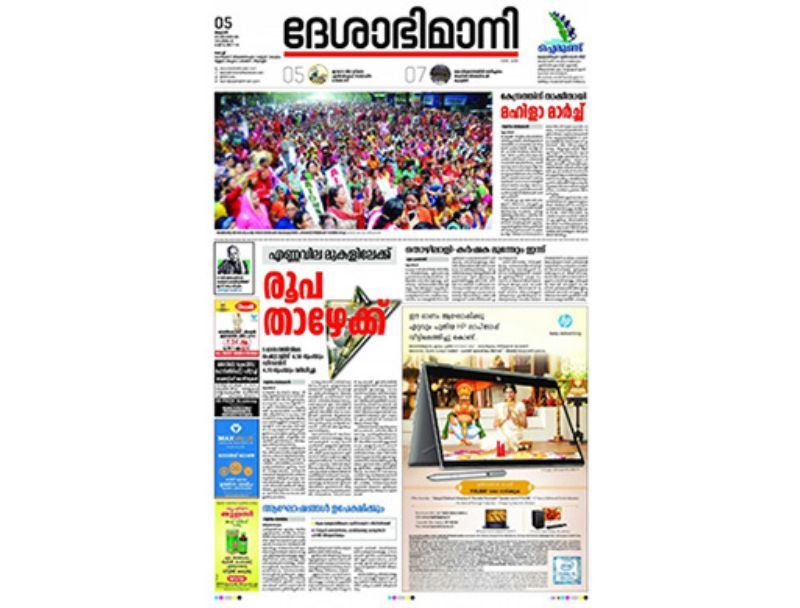
Deshabhimani

Deshabhimani newspaper was founded in 1942 as a successor to Prabhatham weekly which was published in 1935. It was the newspaper of the socialists who were in the Indian National Congress. The first issue of Deshabhimani came out in September 1942 as a monthly. It was then on published by the Communist Party of India, Kerala State Committee. Ever since the split of the Communist party in 1964, the newspaper has been run by the Kerala State Committee of the Communist Party of India (Marxist). It came as the fruit of the efforts taken by AK Gopalan and E M S Namboodiripad because they put in a lot of effort to establish the newspaper. AKG travelled to Burma, Sinhala and other parts to collect money from sympathising Malayalis who settled there and EMS donated money worth his share of ancestral property for the paper.

The position of the newspaper during the second world war has been of much controversy, especially owing to the position of the Communist Party supporting the British when the Soviet Union joined the allied forces against German Fascism. However the newspaper was non-compromising against its position regarding the policies of the Maharajas and the British and the newspaper was often in trouble. It has been written that within a month of its publication, the District magistrate wanted to put a Rs.1000/- bond on it, which it would have to forfeit if it further attacked the British or the Maharajas of Cochin and Travancore. The first fine of Rs.1000/- imposed on it in the aftermath of the hanging of those arrested and convicted as part of Kayyur struggle was collected in no time through a people’s collection. The request of the monthly to be turned into a daily was initially denied by the British government. It was believed that a large section of Malayali men in the army read the deshabhimani weekly during the second world war. It was only after the war ended that Deshabhimani got permission to run it as a daily, which began to be published from Kozhikode in 1946.

About its circulation in the beginning years, the District Magistrate seems to have written, “..has a very large circulation and actually reaches a much larger number of people than its circulation would indicate. My information is that it is read out to the public in many village reading rooms and even read out by communist teachers, who are numerous, to children in the school. It is the most powerful single weapon which the communist possess.”

Deshabhimani remained banned between 1948 and 1951, and thereafter saw itself being structured into a fully functional daily with a circulation of over 2 lakhs daily. Deshabhimani gained in popularity as it constantly reported on people’s struggles and people’s perspectives. During the debate on the Agrarian Relations Bill, 1957, it published the perspectives of Karshaka Sanghams.

The post independence period saw the massive expansion of the newspaper, to become the third largest daily in Kerala currently. Often it was bucket collections from the people which funded the plans for expansion and growth of the newspaper, including the expenditure for new buildings and editions.

Bans/Controversies

The first ban on the paper was for an article written commemorating the 25th anniversary of the Malabar Rebellion by EMS. Thereafter, it was banned between 1948-1951 during the communist party’s active participation during the peasant rebellions owing to the Ranadive Line. During that period, it brought out many other publications such as The Republic, Vishwakeralam, Navalokam and many others in order to survive the ban and bring its ideas to the people.

Again during the Emergency years of 1975-77, the newspaper had to undergo massive censorship, and it was published without an editorial in protest against the government. Often it published blank editorials in protest against the government’s policies and inaction towards the common people. It also forfeited the rights to government sponsored advertisements during the Emergency years.

Other Literary Initiatives

The Deshabhimani Study Circle was established in 1969 as part of the initiative to launch a cultural and literary journal to be produced as an associate publication to the Deshabhimani newspaper. It brought together hundreds of artists across the progressive political spectrum to debate, train and conduct workshops on literary and cultural productions including poetry, cinema, folklore, novels, short stories and so on. This can be considered an attempt to reinvigorate the debate on form and content that took place earlier as well as lessen the differences and antagonisms that emerged because of these debates.

In the most recent interview with Puthalath Dinesan, the Editor in Chief of Deshabhimani, he said that the role of the newspaper was to fight communalism, and neoliberal policies and place a left mandate which can become a model for the rest of the country and to posit an alternative to the Congress and the BJP. Apart from that, he also claimed that the newspaper should be able to spread the message of the party as well as ideas for society’s growth amongst the vast majority of the people.

References

  • P. Govind Pillai. “Deshabhimani Study Circles: Literary Movement in Kerala.” Social Scientist, Vol. 4, No. 2 (September 1975): 56–60.
  • Robin Jeffrey. “Testing Concepts about Print, Newspapers and Politics: Kerala, India, 1800–2009.” The Journal of Asian Studies, Vol. 68, No. 2 (2009): 465–489.
  • K. S. Mochish. “Public Action and Print Media in Kerala: A Historical Analysis, 1923–1965.” Social Scientist, Vol. 42, No. 1/2 (2014): 37–62.
  • ‘Deshabhimani Dinapatram.’ Malayalam Wikipedia (last edited April 2022). Retrieved August 2022, from