


"Explore the rich tapestry of the Malabar region, where centuries of history, culture, and tradition come together.

Get In Touch

img

University of Calicut,
Edapally - Panvel Hwy, Thenhipalam,
Kerala 673635, India

Malabar History journal

  • Home
  • Malabar History journal
Blog Image

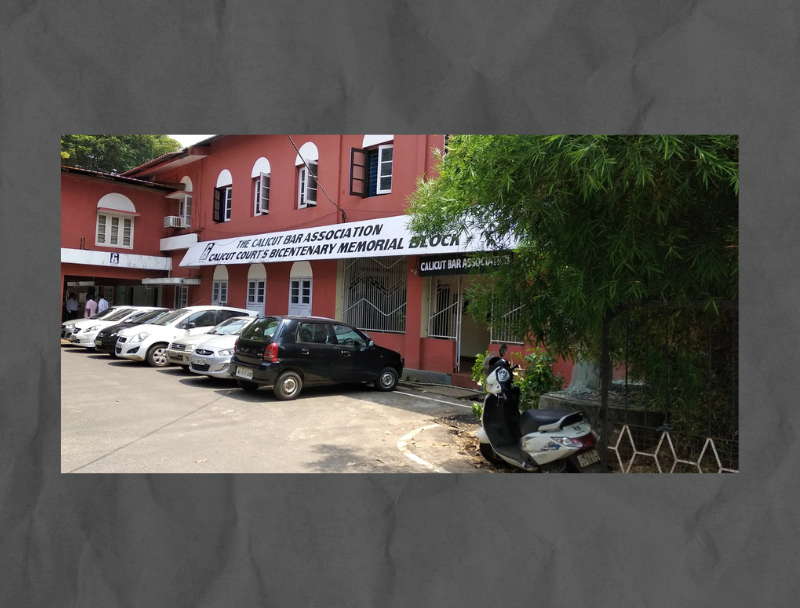
CALICUT BAR ASSOCIATION

Calicut was considered one of the important centres and was the capital of Malabar Province since 1800. Before Kerala State was formed in 1956, the District Court of Calicut was within the jurisdiction of Madras High Court, one of India’s four chartered High Courts. By convention, Calicut District Court was treated as the most important Judicial Centre, next only to the High Court. A District Judge posted at Calicut was usually the senior-most judicial officer, and his next step was to become a judge at the Madras High Court.

The Bar and the Bench of Calicut at the time of British Rule.

Calicut was the headquarters of the then composite Malabar District, taking in the present districts of Kozhikode, Kannur, Malappuram, and Palakkad. There was only one collector for the entire district, but for judicial administration, the entire district was divided into two parts, namely North Malabar and South Malabar. There was one District and Sessions Judge for North Malabar at Tellichery and another for South Malabar at Calicut. There was one Sub Court at Palghat and another at Ottapalam. There was one Principal Sub Judge and one additional Sub Judge at Calicut. The sub-courts were not invested with filing powers regarding appeals. All appeals had to be filed in the District Court. The District Judge periodically transferred civil appeals on his file to the four Sub courts within his jurisdiction. On average, about 1500 civil appeals used to be filed in Calicut district court. All murder cases and other cases to be tried exclusively by a Sessions Judge would be committed to the Sessions Court at Calicut. In those days, the District and Sessions Judge’s work was thus reasonably heavy. The District Court was then presided over invariably by English I.C.S Judges. The Judges used to sit in the court from 11 am to 5 pm, taking a lunch break at 2 pm. Mr. Happel was the last of the English judges to preside at Calicut. He was an ex-military person. 

The Calicut Bar Association- a brief history.

The inception of the Calicut Bar Association can be traced back to a significant meeting held on the 6th of March 1886 at the District Court in Calicut under the Presidency of District Judge Mr. F.H. Wilkinson. During this assembly, a pivotal decision was made to establish a committee comprising the District Judge as the President, the Sub Judge as the Vice President, and four practising attorneys as Members. This committee was entrusted with the responsibility of selecting books and formulating regulations. Another committee, consisting of seven bar members was formed to actively seek donations, resulting in a committed amount of Rs.865/-. Owing to Mr. Wilkinson’s dedicated involvement, the library came to be named after him. The official inauguration of the library occurred during a General Body meeting convened on the 31st of March 1886.

In the initial decade until around 1896, the Association’s leadership structure included the District Judge as President and the Sub Judge as Vice President. Two categories of members, resident and non-resident, were recognized during this period, but post-1892, only resident members were acknowledged. Initially functioning solely as the Library Association, a transformative moment occurred on the 3rd of April 1925. During a meeting of Law Library members, a resolution was passed, integrating the Wilkinson Law Library’s members into the Bar Association. Consequently, the library’s office-bearers assumed ex-officio positions within the Bar Association.
During its nascent stages, the library occupied a room within the District Court building. However, due to space constraints, the library was subsequently relocated to its present edifice, signifying the evolving trajectory of the Calicut Bar Association’s historical development.

Upon the conclusion of its inaugural year, the library, established by the Calicut Bar Association, comprised 58 volumes. An additional 65 books from the District Court were initially provided for the use of the Association’s members. However, this practice of supplying court books to Bar Association members was later discontinued. Subsequently, the Association instituted an annual tradition of procuring new books through Library funds, which has endured to the present day. Moreover, the library’s collection has been significantly augmented through the generous contributions of books from distinguished lawyers and personalities, culminating in its current well-equipped state with an impressive inventory of over 3000 volumes.

The Association, which began with an initial membership of 23 residents and 14 non-residents, has witnessed a steady growth in its member base. Notably, in the 1951-52 period, the Association introduced a tennis court for the recreational benefit of its members.

In 1957, the President of the Bar Association, Sri K.V. Suryanarayana Ayyar, who continued to serve in this capacity even after relocating to Ernakulam on 01.11.1956 as the Advocate General, secured a substantial donation from the late Sri T.K. Ramanatha Iyer. This donation, provided by the son of the esteemed lawyer late Sri T.A. Kalyanakrishna Iyer, played a pivotal role in establishing the Kalyanakrishna Iyer Hall. On 23.07.1957, Sri K.T. Koshy, the Hon’ble Chief Justice of Kerala, laid the foundation stone for this hall. A significant development occurred in 1975 when, under the leadership of President Sri Varkey Paikada, an Annex was constructed to house a Canteen for the members, further enhancing the facilities and services offered by the Calicut Bar Association.

The Calicut Bar Association has consistently demonstrated a commitment to matters of broader public concern, actively engaging in deliberations on significant legislative reforms and conveying its perspectives to the relevant authorities. Notably, influential members such as the late Sir Mannath Krishnan Nair, K.P. Raman Menon, K. Madhavan Nair, K.P. Kutikrishnan Nair, and others have played pivotal roles, contributing significantly to discussions related to Tenancy legislation and the Marumakkathayam Act. During the struggle for independence, members of the Association assumed prominent roles, with figures like the late Sri Madhavan Nair, Sri U. Gopala Menon, and Sri K.P. Kesava Menon served as pioneers in the movement. Some members, including Messrs K.V. Gopala Menon, P. Achuthan, A. Karunakara Menon, and K. Kesavan Nair, temporarily relinquished their legal practices. Others, such as Sarvashri K. Madhavan Nair, U. Gopala Menon, A. Karunakara Menon, Kozhipurath Madhava Menon, K.P. Ramunni Menon, K.P. Kutikrishnan Nair, P.I. Kaimal, M. Govinda Menon, V. Raman Menon, and K. Bhaskara Menon, faced imprisonment. Notably, Sri K. Madhava Menon and Sri K.P. Kutikrishnan Nair later served as Law Ministers in the Madras Cabinet prior to the dismemberment of the Presidency. Late Sri Kongat Raman Menon, a significant participant in the movement, passed away while holding the Minister for Court and Prisons position.

The Association faced the repercussions of government repression in 1942 when it was evicted from its premises for a month (December 1942). This action was taken because the Association had used its premises to discuss political matters unrelated to the legal profession, passing a resolution condemning a speech disparaging India by the British Premier, Churchill.

Members of the Bar Association actively participated in municipal affairs, with the first Chairman of Calicut Municipality, Sarvashri Manjeri Subramania Iyer, being a Calicut Bar Association member. Notable individuals like Sri C.V. Narayana Menon, Sri E. Narayanan Nair, Sri U. Gopala Menon, Sri K.V. Suryanarayana Iyer, Sri K. Madhava Menon, Sri K.P. Kutikrishnan Nair, and Sri P. Govinda Menon were also members of Calicut Municipality. Following Calicut’s elevation to a Corporation, Sri P.V. Sankaranarayanan and Sri C.J. Robin assumed the position of Mayors. The Bar Association’s involvement in legislative discourse and civic affairs underscores its enduring commitment to societal welfare.

Following the establishment of the state of Kerala, the then President of the Bar Association, Sri K.V. Surya Narayana Iyyer achieved a distinguished milestone by being appointed as the first Advocate General of Kerala—a rare honour for lawyers hailing from rural regions. In the subsequent years, the Association witnessed the elevation of notable members, with Sri P. Govinda Menon and Sri S.K. Kader assuming positions as Judges in the High Court. At the same time, Sri P.K. Sankaran Kutty and Sri P.V. Sankaranarayanan took on roles as members of the Legislative Assembly.

The Bar Association celebrated its Golden Jubilee in 1936 and its Diamond Jubilee in 1950. A significant event in its history was the hosting of the Madras State Lawyers Conference in Kozhikode, where distinguished figures such as the then Attorney General of India, Sri M.C. Setalvad, and Hon’ble Supreme Court Judge Sri P. Govinda Menon provided valuable guidance during the proceedings. In 1973, the Association organized the first Conference of Lawyers from all over Kerala, featuring the guidance of Hon’ble Justice P.N. Bhagavathi and Hon’ble Justice V.R. Krishna Iyer. During this conference, the then President of the Bar Association, Sri Joseph Jacob, achieved a unanimous election as the inaugural President of the Kerala Bar Federation upon its establishment. These milestones underscore the Association’s enduring legacy and its pivotal role in the legal landscape of Kerala.

The Members of the Bar

In 1930, the Calicut Bar had about 145 members. Of these, about 65 were Brahmans, an equal number of Nair advocates, 2 Muslims, 3 Christians and about half a dozen members of the Thiyya Community. There was not even a single lady advocate then at Calicut. Many eminent and famous lawyers decorated the Bar with their names, fame and intellectual calibre. Calicut Bar was one of the best and strongest bars in the erstwhile composite Madras state, of which Malabar was part.

References

  • Clarion-12, 125th Year Celebration Souvenir, Calicut Bar Association, 2012.
  • VOX CBA: Souvenir on Commemorating the Establishment of Bicentenary Memorial Court Complex and Celebrating 135 Years of Calicut Bar Association, 2021.
  • https://districts.ecourts.gov.in/koz_bar